
WHEN THE SITE ITSELF IS THE PROBLEM
Fake dating sites: bots, fictional profiles and paid chat
Sometimes the risk is not a scammer who has joined a genuine service. It is the operator’s own business model: fictional profiles and automated or staff-written messages that make a site appear full of interested people. The visitor is encouraged to pay, even though the conversation may never lead to a real meeting.
This guide concerns operator-run deception. It does not claim every paid dating service or every use of automation is a scam.
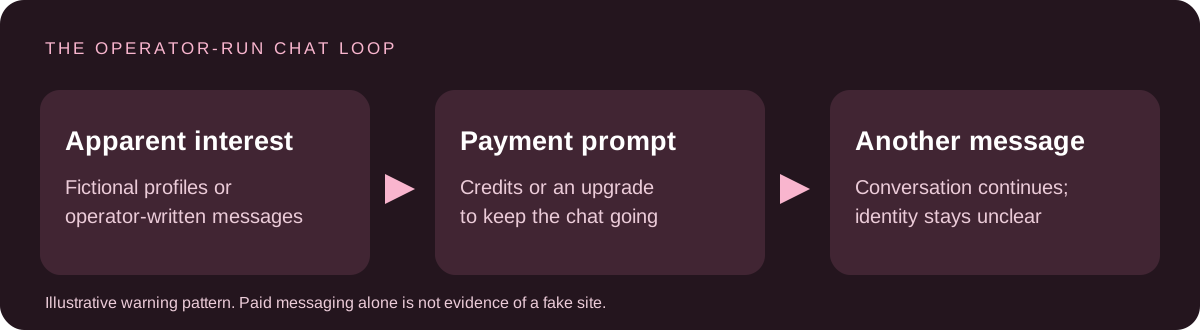
01 / THE HOOK
Instant attention
A very short signup, sometimes one or two questions, is followed by messages before you have said much about yourself.
02 / THE PAYWALL
Pay to continue
A reply, another message or a photo requires credits or a paid plan. The interface keeps attention on the conversation rather than its origin.
03 / THE LOOP
More chat, no clarity
Messages prolong the exchange while questions about identity or meeting remain unanswered. Spending can continue without a real prospect of a date.
Read who is allowed to operate the profiles
Look in the terms and profile labels for references to fictional profiles, entertainment profiles, virtual members, chat operators or messages sent on behalf of the service. Read the full explanation: does it say a physical meeting is impossible, or that some profiles are not real members?
Those terms are not a universal checklist or proof by themselves. The important question is whether you understand whom you are talking to before spending. A clearly labelled fictional chat product is different from selling it as access to real nearby dates.
Why a one-question signup can be part of the funnel
Some deceptive sites collect almost nothing before showing apparent matches and urgent messages. That speed can move people toward payment before they examine the service. But a short signup alone proves little: genuine services also reduce questions for privacy and convenience.
Assess the combination of minimal profile information, immediate attention, vague identity, payment pressure and small print about fictional interaction.
Do not treat “online now” as verification
Status badges, profile pictures and a stream of notifications are interface elements. They do not establish that the person shown controls the account. Notice whether replies address what you actually wrote or simply introduce another topic that requires a paid reply.
Check the charging model
Is the charge for a subscription, individual messages or a bundle of credits? How much does one complete conversation cost? Read renewal and cancellation details, and avoid buying more simply because you have already spent money.
Paid messaging itself is not evidence of a fake service. The distinction is whether the offer and the identity of participants are represented honestly.
Questions to ask before paying
- Can the operator create profiles or send messages as members?
- Are fictional or staff-operated profiles clearly labelled?
- Does the service say that meeting these profiles is impossible?
- Can I see the full price and renewal terms?
- Is there a clear company identity and support route?
How our network guide fits in
This guide is published by dm³ LTD. Latex Dating and Nude Dating are operated by third-party provider HubPeople. Saucy Dates does not create profiles to simulate member interest. Its paid private messaging feature is described separately from free signup, Hots and flirts. That does not guarantee that every member is genuine or will reply.
Compare our services and check what is free. For suspicious behaviour by an individual member, see Saucy Dates safety guidance.